A plain walk through solid-phase peptide synthesis, cleavage, HPLC purification and freeze-drying, and what each step leaves behind in the vial.
The Short Version
Most research peptides are made by solid-phase peptide synthesis, usually shortened to SPPS. The chain is built one amino acid at a time while anchored to tiny resin beads, then cut free, purified by chromatography and freeze-dried into the powder that ships in a vial. Each of those stages leaves a mark on the final product, which is why purity, identity and peptide content are reported separately on a certificate of analysis.
Building the Chain on a Resin
Solid-phase synthesis was introduced by Bruce Merrifield in the 1960s, work later recognised with a Nobel Prize. The key idea is to attach the first amino acid to an insoluble support, a polymer resin, so that every reagent can be washed away after each step while the growing chain stays put.
The chain is assembled from the C-terminus to the N-terminus, the reverse of the direction in which it is usually written. The choice of resin decides how the finished peptide ends: some resins release a free acid at the C-terminus, while amide resins release a C-terminal amide, a common feature of naturally occurring peptides.
One Amino Acid at a Time
Today the most widely used approach is Fmoc chemistry. Each incoming amino acid has its amino group protected by an Fmoc group, and any reactive side chain carries its own protecting group. A synthesis cycle repeats the same steps for every residue.
- Deprotection: the Fmoc group on the end of the chain is removed, usually with piperidine.
- Washing: the resin is rinsed to clear the reagents.
- Coupling: the next protected amino acid is activated and joined to the free amino end.
- Washing again, before the next cycle begins.
Automated synthesizers run these cycles for hours or days. Each coupling is very efficient but not perfect, and small losses add up over many cycles, which is one reason long sequences are harder to make in high purity than short ones.
Cleavage: Releasing the Peptide
When the sequence is complete, the peptide is cut from the resin with a strong acid, typically trifluoroacetic acid (TFA), mixed with scavenger compounds that capture reactive fragments. The same step removes the side-chain protecting groups. The crude peptide is then precipitated, usually with cold ether, and collected.
At this point the material is a mixture: the target peptide plus shorter chains and other by-products of synthesis.
Purification by Reverse-Phase HPLC
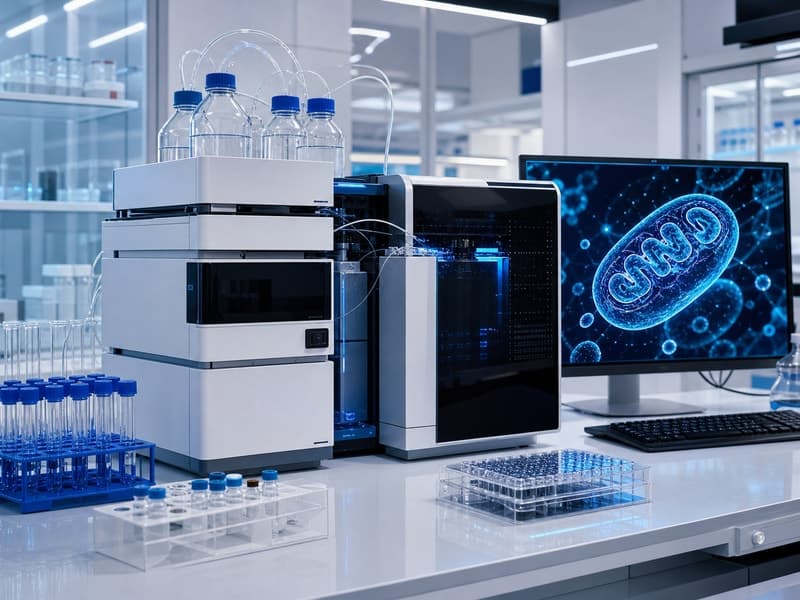
Crude peptide is purified by preparative reverse-phase high-performance liquid chromatography. The mixture is pumped through a column packed with a hydrophobic material, and a gradient of water and acetonitrile separates components by how strongly they interact with it. The mobile phase usually contains a small amount of TFA.
Fractions coming off the column are checked by analytical HPLC and mass spectrometry, and only those that meet the purity target are pooled. This is the stage that determines the purity figure reported on the COA.
Freeze-Drying Into a Powder
The pooled fractions are lyophilized: frozen and placed under vacuum so the water and solvent sublime away. What remains is a light, dry solid, often seen as a white cake or powder at the bottom of the vial. Lyophilized material is far more stable in storage than peptide kept in liquid form, which is why research peptides are supplied this way.
What Synthesis Leaves Behind
Knowing the process makes the impurities on a certificate of analysis easier to interpret.
- Deletion sequences: chains missing one residue, from an incomplete coupling.
- Truncated sequences: chains that stopped growing before the end.
- Incompletely deprotected chains: a protecting group that survived cleavage.
- Counter-ions: because TFA is used in cleavage and purification, peptides are commonly isolated as TFA salts unless they are exchanged to acetate or another salt form.
- Residual water bound to the dry powder.
The first three lower HPLC purity. The last two do not show up as purity impurities at all, but they do make up part of the weight in the vial, which is the difference between purity and net peptide content.
Modified Peptides
Many catalog peptides carry modifications added during or after synthesis: an amidated C-terminus, an acetylated N-terminus, a disulfide bridge that closes the chain into a ring, or an attached fatty-acid or polyethylene glycol chain. These are part of the defined structure and appear in the full product name or specification. Very long sequences may be assembled from shorter synthesized pieces, or produced by recombinant expression instead of SPPS.
Why This Matters When You Buy
The synthesis route explains what to look for in the documentation. HPLC purity tells you how much of the peptide-related material is the target sequence. Mass spectrometry confirms the target is the right molecule. The salt form and net peptide content tell you how much of the weight in the vial is peptide at all. Reading all three together gives a far better picture of a lot than any single number.
Key takeaways
- 01Most research peptides are made by solid-phase synthesis, built from the C-terminus one residue at a time.
- 02Cleavage with TFA releases the chain; reverse-phase HPLC then sets the final purity.
- 03Freeze-drying produces the dry powder that keeps far better in storage than a liquid.
- 04Deletion and truncated sequences lower purity; counter-ions and water lower net peptide content.
Frequently asked
What is solid-phase peptide synthesis?+
Why are research peptides supplied as a freeze-dried powder?+
Why do many peptides come as TFA salts?+
Research Use Only. This article is educational and describes research-use materials only. Flintmarrow products are not drugs or supplements and are not for human or veterinary use.
Need product or lot details confirmed?
Browse USD pricing where published, then ask about current specifications, available documents and shipping for your order.